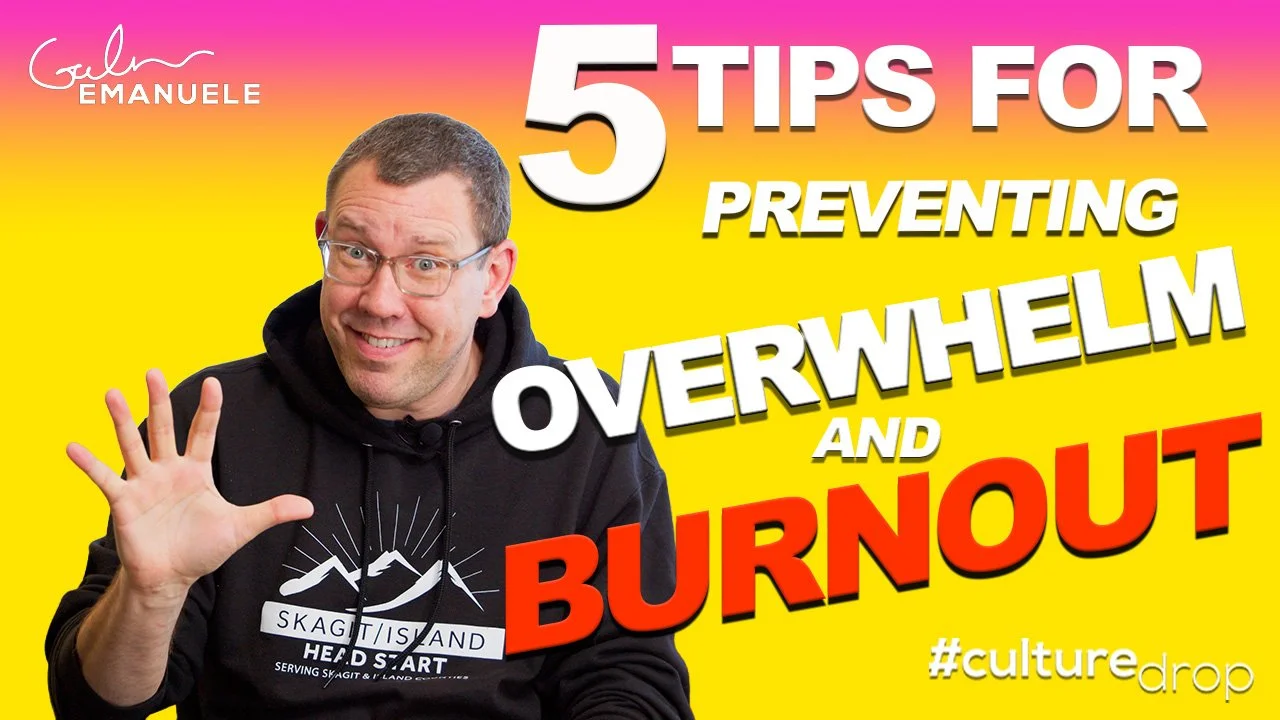
5 Good Questions to Prevent Overwhelm & Burnout
Welcome to the #culturedrop. Every Tuesday, Galen Emanuele emails tools to advance leadership skills, team culture, and personal growth. No spam, just great content. Sign up now to get it in your inbox.
Five questions to help you fight overwhelm and burnout before they win.
Overwhelm is real. Burnout is real. Work is hard, and most of us are carrying a lot (professionally and personally) at any given moment. When everything piles up at once, it's easy to hit a wall where nothing gets done because everything feels urgent and it’s all too much.
This is a framework of five questions designed to help you assess and identify where you're at, pinpoint what's actually causing stress, and find a clear next step.
This is great as a tool for leaders to use with their teams and individuals, and these questions also work just as well as a personal check-in. Use them proactively in one-on-ones, or pull them out when you're already in the weeds or have sunk into a pit of overwhelm.
“A lot of the time we absorb stress and carry it without actually acknowledging what’s happening or being able to see the big picture.”
Question 1: How full is your plate & what’s actually on it?
On a scale of 1 to 10, what's your current capacity? This sounds almost too simple, but naming it matters. A lot of the time we absorb stress and carry it without actually acknowledging what's happening or being able to see the big picture.
Being able to say "I'm at a 9 out of 10 right now and here’s everything on my plate” is a useful starting point — for yourself and for anyone supporting you.
Question 2: What's causing the most stress?
Even if you have 20 things on your plate, there's usually one (maybe two) that's the real thorn in your side, the thing bubbling up and creating the most stress and pressure.
Identifying that specific thing helps you stop treating everything as equally urgent. It often grants a little dose of reality and perspective, and gives you something concrete to work with.
Question 3: What's actually at risk?
This is the reality check. If things stay as they are, what's genuinely at risk of falling apart — a deadline, a relationship, a deliverable? Sometimes when we're overwhelmed, it feels like everything is about to collapse. But when you sit with this question, it can often bring you to the realization that the actual high-stakes items are fewer than they seem.
“Naming it explicitly means you can stop carrying it as a vague, lurking anxiety and start dealing with it directly.”
And if something truly is at risk, naming it explicitly means you can stop carrying it as a vague, lurking anxiety and start dealing with it directly.
Question 4: What's the priority?
This is the question that helps pull you out of the spiral. If you ranked everything on your plate from most to least important, what would sit at the top?
Better yet — what's the one next, and most crucial thing you can singularly focus on and actually do right now? For me the biggest cure for overwhelm and pulling myself out of a funk is usually just doing enough to get one scary and daunting thing off my plate.
“For me the biggest cure for overwhelm and pulling myself out of a funk is usually just doing enough to get one scary and daunting thing off my plate.”
Another bonus, sometimes reprioritizing also means giving yourself permission to move things off the list entirely. If two or five or six items can wait until tomorrow or next week with no real consequence, recognizing that creates breathing room immediately.
Question 5: What do you need?
For leaders asking this of a team member: how can I support you? Can I take something off your plate? Do you need space, help, or just someone to think through the list with you?
For yourself: what do you need right now, in this moment? Sometimes the answer has nothing to do with the work at all — a walk around the block, lunch, a break from the screen. Those things are often a gigantic help. Taking care of yourself before you're running on empty is clutch.
“Taking care of yourself before you’re running on empty is clutch.”
A handy, useable check-in.
These five questions aren't just useful as a crisis tool. They're a solid regular check-in — whether you're leading a team or just trying to stay on top of things yourself.
Life is a lot. Having a simple framework to check in before sinking into a pit of overwhelm or burnout makes a real difference.
Related Blogs:

Want more?
This article was created by Galen Emanuele for the #culturedrop. Free leadership and team culture content in less than 5 minutes a week. Check out the rest of this month's content and subscribe to the Culture Drop at https://bit.ly/culturedrop
MORE