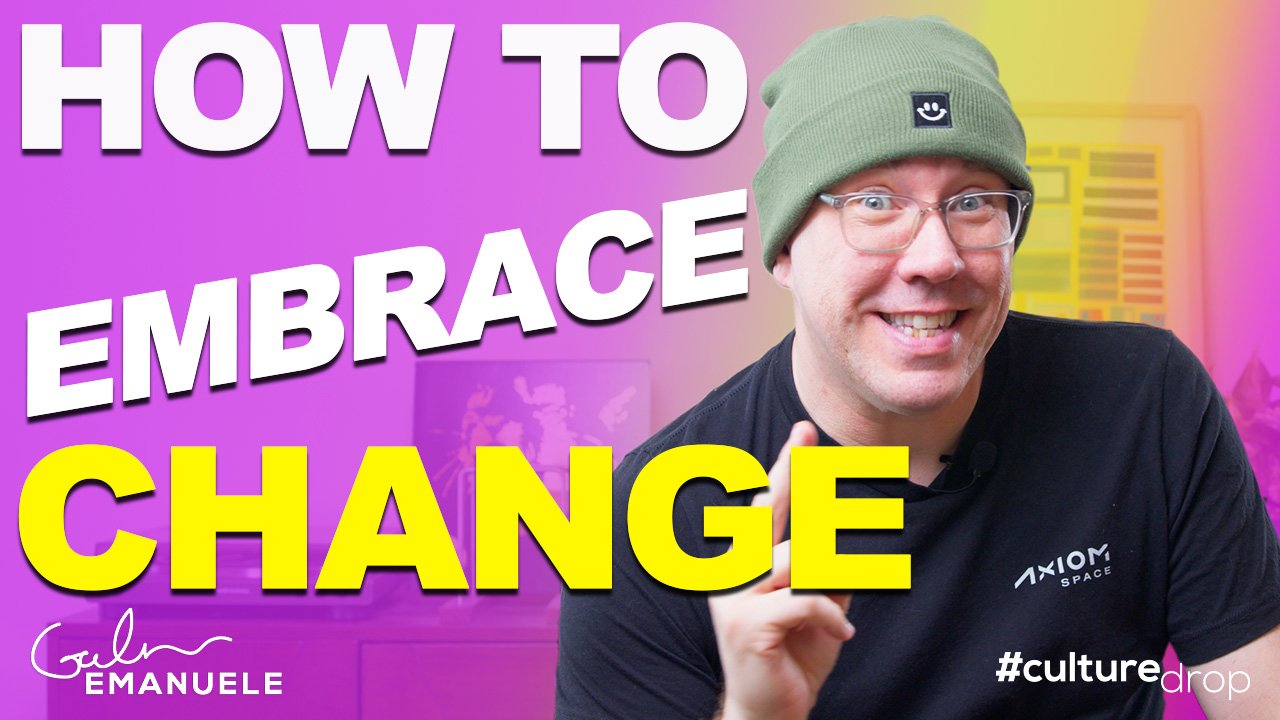
Embracing Change More Effectively
Welcome to the #culturedrop. Every Tuesday, Galen Emanuele emails tools to advance leadership skills, team culture, and personal growth. No spam, just great content. Sign up now to get it in your inbox.
Staying level-headed through change.
Change is constant. It shows up in organizations, teams, and our personal lives. Strategies shift. Roles and relationships evolve. Priorities get redefined. At work and at home, we are always moving through something new.
The real differentiator is not whether change happens, it’s your reaction and relationship with it.
Some people embrace and walk alongside change. Others have it drag them through the mud. Either way, it’s coming, and what it feels like along the way is largely an inside job.
For professionals, this matters. Your ability to navigate change with resilience and clarity has a direct impact on your performance, your leadership, and your overall well-being. Change agility is a skill that should absolutely be on your radar, and seeing that change is inevitable, might as well be something you’re great at.
“No matter how reluctant or resistant you might feel about it, change is constantly arriving and has no regard for your comfort level with it.”
Change is inevitable. And your experience of it is largely up to you.
No matter how reluctant or resistant you might feel about it, change is constantly arriving and has no regard for your comfort level with it. It’s not something you can opt out of.
But you can choose your mindset and how you move through it.
Improving your relationship with change starts the same way you’d approach any skill you want to develop. Go learn.
There are countless hours of content available to you right now on the internet at your disposal. If you were to spend 30 to 60 minutes reading or listening to credible books or articles or experts on adaptability and resilience, you can meaningfully upgrade your perspective in a single sitting.
That external learning matters, and there are plenty of great tips and tools to discover and utilize.
And no one asked me, but here are a few things from my own personal bag of tricks that help me to move through change and not suffer a ton in the process.
Three principles that help me immensely when it comes to change and resilience.
Over time, I’ve found these three ideas especially helpful in staying grounded during uncertainty or change. They’re rooted in the principles of Buddhism, and I find that they apply broadly in professional and personal life.
1. Impermanence
Nothing is permanent.
The best seasons of your career or life; the toughest quarters, the project that feels overwhelming, the stretch where everything clicks (or nothing does at all), your highest highs and lowest lows — all of it is temporary.
“The best seasons of your career or life; the toughest quarters, the project that feels overwhelming, the stretch where everything clicks (or nothing does at all), your highest highs and lowest lows — all of it is temporary.”
When you truly internalize the reality of impermanence, you stop treating any current moment as fixed, like it will stay forever.
Everything comes and goes. All the great and terrible moments in life come and go like weather that will pass. It helps soften the blow of hard times and change, and it makes the sweet moments even sweeter to embrace a mindset of impermanence.
This mindset creates steadiness. It reduces panic in downturns and complacency in upswings. It helps you see change not as a disruption, but as a natural state. Nothing lasts forever.
2. Detachment from outcomes.
Detachment does not mean indifference. It means not gripping a specific outcome so tightly that your well-being depends on it.
“Detachment does not mean indifference. It means not gripping a specific outcome so tightly that your well-being depends on it.”
In professional settings, it’s easy to become attached to how a project “should” unfold, how a reorg “should” look, or how a conversation “should” go. The tighter the attachment, the greater the frustration when or if reality diverges from the plan.
You control your preparation, your effort, your integrity, and your communication. You cannot control every variable or final outcome.
Holding on lightly allows you to stay focused and committed without tying your emotional state to factors outside your control. It reduces unnecessary suffering while preserving accountability and drive. Do your absolute best, let the chips fall where they may. Repeat.
3. Presence.
Anxiety is a result of living in the future and anticipating negative experiences. Regret or lamenting is a result of living in the past.
Presence keeps you in the now of your life and anchors you to what is true and real right now.
When you are present, you are less likely to spiral into imagined worst-case scenarios that may never happen. You are also less likely to romanticize the past and resist necessary evolution and changes.
In practical terms, presence is about asking and remaining in a space of: What is my current reality in this moment? What is within my control to affect or impact? What is the best I can do or next step forward?
This shift keeps you grounded. It channels your energy into action or stillness instead of rumination.
“When a big, unexpected shift happens, an ideal scenario isn’t one where you stop caring. It’s one that avoids unnecessary suffering while you move through it.”
A healthier relationship with change.
If it’s something you struggle with, you can’t just will yourself to suddenly “like” change. But you can work on building a healthier relationship with it.
Start by educating yourself. Invest time in learning about adaptability and resilience and some tools that you find valuable and practical. Then work on the internal side:
Embrace impermanence.
Loosen your attachment to specific outcomes.
Practice staying present.
When a big, unexpected shift happens, an ideal scenario isn’t one where you stop caring. It’s one that avoids unnecessary suffering while you move through it.
Change will continue to arrive in your life, that’s a guarantee. The opportunity is to meet it with steadiness, clarity, and a mindset that allows you to grow and come out on top rather than grind through the mud.
That shift can transform how you lead, how you perform, and how you experience change in your life and work.
Related Blogs:
Comfort is Counter to Ambition

Want more?
This article was created by Galen Emanuele for the #culturedrop. Free leadership and team culture content in less than 5 minutes a week. Check out the rest of this month's content and subscribe to the Culture Drop at https://bit.ly/culturedrop
MORE